

Why Leaders Often Solve the Wrong Problem

CTO
It sounds decisive. Strategic. Modern. And more often than not it’s wrong.
Not because automation is the wrong idea, but because it’s being applied at the wrong level.
A Familiar Moment
A leadership team once asked me to automate an entire operational workflow. It touched multiple systems, several teams, and had been labeled “inefficient” for years.
Before doing anything technical, we mapped the process step by step.
The surprise wasn’t how broken it was—it was how little of it actually needed automation.
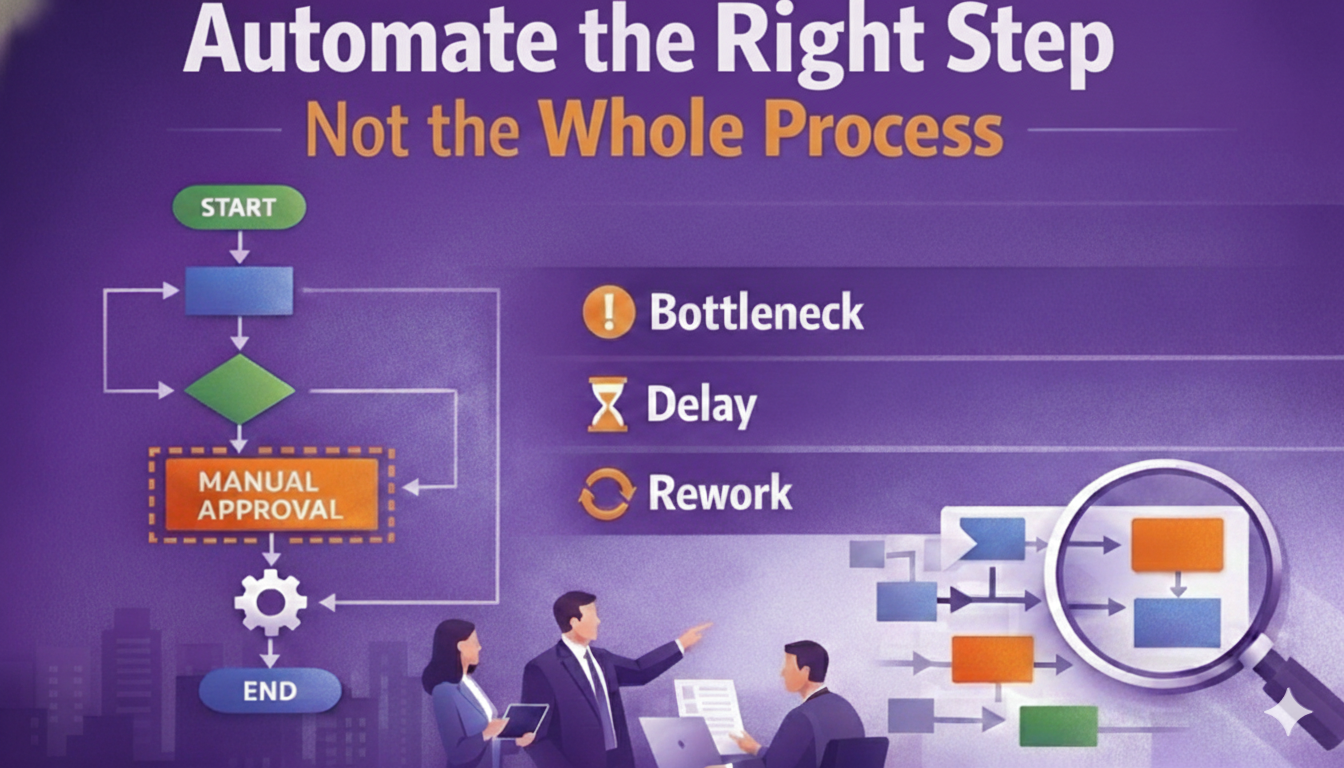
One manual decision point, buried deep in the SOP, forced rework across three downstream teams. That single step accounted for the majority of delays, exceptions, and frustration.
We didn’t automate the process. We automated one step.
Cycle time dropped materially. Error rates fell. The rest of the workflow suddenly worked just fine—without millions spent or months of disruption.
That’s when it clicked (again): most leaders don’t have an automation problem. They have a precision problem.
The Process Is Rarely the Problem
Most workflows are not uniformly broken. They are uneven.
Eighty percent of the process may function well enough. Twenty percent creates drag that ripples everywhere else. But because the pain shows up at the end, leaders assume the entire thing needs to be replaced.
This is how organizations:
- Automate complexity instead of removing it
- Encode bad assumptions into software
- Spend heavily while fixing very little
Technology doesn’t fix unclear thinking. It amplifies it.
When automation is applied without isolating the constraint, inefficiency doesn’t disappear—it gets industrialized.
Precision Before Scale
The most effective leaders I’ve worked with do something counterintuitive before they automate.
They slow down.
They zoom in instead of out. They isolate exactly where work stops flowing. They ask why a step exists, not just how to speed it up.
Very often, the answers sound like:
- “We don’t trust the data.”
- “No one owns this decision.”
- “This was added years ago and never revisited.”
Those aren’t technology problems. They’re leadership problems.
Sometimes the right move is automation. Sometimes it’s elimination. Sometimes it’s a policy decision that never should have become a workflow.
Why Leaders Keep Missing This
Leaders are rewarded for momentum, not precision.
“Automate the process” feels bold. “Fix one step in the SOP” feels small—even when it delivers far more impact.
But scale without clarity creates complexity. And complexity is the tax every growing organization eventually pays.
The best automation efforts I’ve seen were surgical. One constraint at a time. One bottleneck removed before moving to the next.
Simplify first. Then accelerate.
Solve the Right Problem
Technology is a force multiplier—but only when it’s applied to the right constraint.
If you automate the wrong thing, you don’t get efficiency. You get faster confusion, brittle systems, and frustrated teams wondering why the investment didn’t pay off.
The leaders who get this right don’t ask: “What can we automate?”
They ask: “Where does work actually break down?”
Solve that problem—and automation becomes transformative. Solve the wrong one—and you just make inefficiency move faster.
Precision beats scale. Every time. Where have you seen automation applied too broadly or too shallow?